@groeponline/pi-agent-control-extension
extensionmaintainedPi extension for terminal, CLI, browser-routing, capture, QA evidence, verification, usage observability, and control hub workflows
by — · v5.8.0 · published 1d ago
$ pi install npm:@groeponline/pi-agent-control-extensionSignals
Download trend
No downloads in the last 12 weeks.
README
Pi Agent Control Extension
Capture what the agent actually did, not just what it says it did.
Route terminal and browser work to the right driver, record the run, and turn it into QA evidence, screenshots, casts or showcase video.


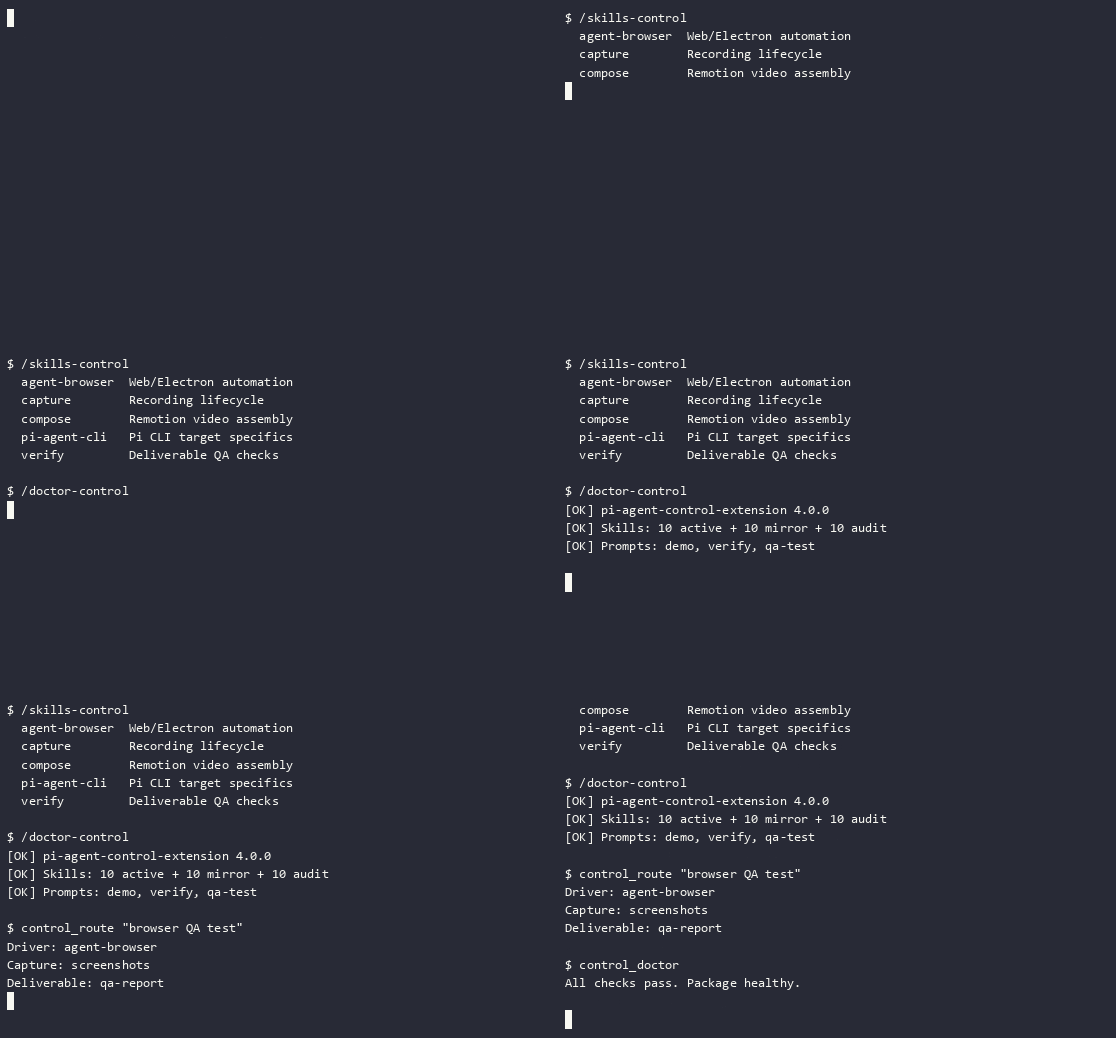
Recorded package output. The demo is evidence from the control surface, not a designed mockup.
Start in 10 seconds
pi install npm:@groeponline/pi-agent-control-extension
Then capture something real:
/capture https://example.com --format mp4
Or capture a terminal flow:
/capture "npm run dev" --format cast
The extension picks the driver, writes the artifact and returns evidence you can inspect instead of a prose-only success claim.
Three useful entry points
/route-control "verify this browser flow"
/verify-control
/qa-control
/route-controldecides which driver, skills and capture format fit the task./verify-controlgives the required commitment/evidence contract./qa-controlproduces the QA report structure for expected vs observed behavior.
What this package owns
QA routing, terminal/browser capture, evidence, Skill Studio and showcase workflows. It does not own Pi session/model/tool-state control; use @groeponline/pi-control for that. It also does not own durable task state or multi-agent execution.
| Need | Package |
|---|---|
| Operator cockpit and quick idea capture | pi-wishcraft |
| Durable missions across sessions | pi-missions |
| Parallel agents, worktrees, swarms, schedules | pi-agent-orchestrator |
| Live Pi session/model/tool/state control | pi-control |
| QA evidence, capture and showcase proof | this package |
A normal portfolio flow is idea → mission → orchestration run → evidence.
// CAPABILITIES
| Area | Capability |
|---|---|
| Routing | Maps task intent to tuistory, true-input, or agent-browser |
| Capture | Forces outputs to casts, screenshots, mp4, or report-only evidence |
| Verification | Outputs commitment and evidence schemas for audit-friendly proof |
| QA | Enforces QA report structures with expected, observed, result, and evidence states |
| Showcase | Executes recipes for demo capture and Remotion-based composition |
| Guardrails | Intercepts risky capture and shell patterns prior to execution |
| Testing | Mandates unit, E2E, strict TypeScript (Vitest), and Ruff Python validation |
// COMMANDS
| Command | Action |
|---|---|
/skills-control | Outputs bundled skill atoms |
/route-control <task> | Routes task to driver, skills, capture, deliverable, warnings, and recipe |
/capture <target> [--format mp4|cast|png|report] | Executes unified evidence capture; auto-selects driver and format |
/showcase-preview <recipe> | Outputs showcase render props for a recipe |
/showcase-render <recipe> | Executes a Remotion showcase video render from a recipe |
/skill-merge <name> | Executes 3-way merge of a user skill with the PI version |
/merge-list | Outputs all recorded skill merge states |
/bridge-start [--port] | Initializes remote agent WebSocket bridge |
/bridge-status | Outputs remote agent bridge status |
/demo-control | Outputs canonical tuistory capture recipe |
/verify-control | Outputs required verification and evidence schema |
/qa-control | Outputs QA report template |
/doctor-control | Executes package validator |
// CAPTURE & SHOWCASE
Capture evidence with unified commands. The orchestrator inspects the target, determines the optimal driver (agent-browser, tuistory, or true-input), and outputs the evidence artifact.
/capture https://example.com --format mp4
/capture "npm run dev" --format cast
/capture "tui-story login" --format report
Supported formats: mp4, cast, png, report.
Results are strictly validated against the evidence schema and accessible in the Skill Studio TUI evidence pane.
// SHOWCASE RENDERING
Convert a capture run into a Remotion showcase video. Recipes automate preset, layout, and transition selection.
/showcase-preview showcase-compose
/showcase-render showcase-compose
/showcase-render tuistory-launch artifacts/runs/run-2026-05-27/evidence/capture.cast
Available recipes: tuistory-launch, browser-loop, showcase-compose, qa-report.
Manual shell execution:
npm run showcase:render -- showcase-compose
// SKILL MERGE
Resolve overrides between user skills and PI skills via 3-way merge.
/skill-merge agent-browser
/merge-list
Conflicts are presented with line-level context. Resolution requires --pi, --user, or --manual. Merge state is committed to ~/.config/devin/skill-studio.json.
In the Skill Studio TUI, press m on a selected skill to initialize the merge sequence.
// REMOTE AGENT BRIDGE
Exposes the extension via a WebSocket server for remote agent or CI system capture and render triggers.
/bridge-start 8765
/bridge-status
Connection target: ws://localhost:8765?token=<TOKEN>
Permitted message types: ping, skill.list, capture.start, render.start, bridge.status, bridge.broadcast.
// LLM TOOLS
| Tool | Function |
|---|---|
control_route | Routes a task programmatically |
control_recipe | Outputs a canonical workflow recipe |
control_evidence_schema | Outputs the evidence schema |
control_skill_index | Outputs bundled skills and missing expected skills |
control_doctor | Executes package validation |
control_verify_commitments | Validates a verification report against core commitment and evidence sections |
// SKILL ATOMS
Control Skills:
agent-browser · capture · compose · pi-agent-cli · pi-agent-control · pty-capture · showcase · true-input · tuistory · verify
Advanced/Chained Skills:
init · wiki · review · autoresearch · session-navigation
// ARCHITECTURE & ROUTING
The project follows a Clean Architecture pattern (src/drivers, src/extension, src/skill). Consult ARCHITECTURE.md for a deep dive into the layer boundaries and routing terms (tctl, control cli, pi agent, pi cli, pi coding), which select background-pty.
graph TD
    A[User Task Intent] --> B{Router Logic}
    B -- "Web / Electron QA" --> C[agent-browser driver]
    C --> C1[screenshots]

    B -- "Ghostty / Wezterm / Vim" --> D[true-input driver]
    D --> D1[mp4 / raw PTY]

    B -- "CLI / TUI Snapshot" --> E[tuistory driver]
    E --> E1[asciicast / text snapshots]

    B -- "Chained Analysis" --> F[mixed driver]
    F --> F1[init + wiki + review + autoresearch]
// EVIDENCE CONTRACT
Run execution strictly mandates a stable directory schema:
artifacts/runs/<timestamp>-<slug>/
  run.json
  transcript.md
  evidence/
  verification.md
Claims must explicitly map to a step, driver, evidence file, result, and reason. Tasks are designated incomplete until visible evidence supports the specified commitment.
// GUARDRAILS
The extension intercepts shell-style tool calls and explicitly blocks non-compliant patterns, including broad rm -rf, direct .env read/write operations, omitted --repo-root in pi-agent launches, and tuistory launches lacking color-preserving environment variables.
// SECURITY HARDENING
Defense-in-depth is enforced across all user input and network I/O modules:
| Layer | Implementation |
|---|---|
| Path Traversal | Skill names adhere strictly to ^[a-zA-Z0-9_-]+$ preceding filesystem operations (mergeSkill, resolveMerge, checkSkillUpdateConflict). |
| Path Traversal | showcaseRender rejects ../ and absolute paths in capturePath and outPath prior to script execution. |
| Memory Leaks | WebSocket bridge flushes clients on close and error events; server faults trigger state reset. |
| Resilience | capture.ts enforces try/catch on mkdirSync — execution is non-fatal on failure. |
| Input Validation | validateEvidence() enforces length bounds, required fields, and format compliance against the schema. |
| Shell Safety | Driver modules isolate command string generation from execution. Direct exec calls are strictly prohibited; execution relies on the host shell or Pi tool system. |
// PRIVACY & NETWORK BOUNDARY
The extension has no package-owned telemetry service. QA evidence and capture artifacts are local unless an operator explicitly points a driver or bridge at another endpoint. The WebSocket bridge is opt-in and bearer-token protected; exposing it outside a trusted local/network boundary is an operator decision.
/showcase-render uses the bundled Remotion workspace. A normal npm/Pi install does not auto-install that nested renderer workspace; when renderer dependencies are absent the command reports the requirement instead of attempting a broken render. A source checkout can enable rendering with npm run setup. The core control, routing, verification, and capture surfaces do not require a hosted ChefGroep control plane.
// VALIDATE & TEST
# Validation
npm run validate
npm run pack:dry
npm run verify:package

# Unit Tests (Vitest & tsx)
npm test
npm run test:watch

# E2E Tests
npm run test:e2e

# Python Skills (unittest)
pytest packages/skills
npm run validate executes structure, manifest, skill inventory, and demo artifact verifications. npm run verify:package additionally inspects the actual npm tarball and fails if the Pi extension entrypoint, bundled skills, validator, or license would be omitted.
// ROADMAP & FUTURE PLANS
Consult ROADMAP.md for architectural vectors, encompassing LLM-powered guardrails, native Playwright integration, and remote tmux orchestration.