@getpipher/armory-mesh
extensionmaintainedHardened peer-to-peer mesh for pi agents — live presence, work claims, cross-session duplicate checks, and a durable fleet memory for N parallel sessions. Signed + secured by default.
by — · v0.1.3 · published 4w ago
$ pi install npm:@getpipher/armory-meshSignals
Download trend
No downloads in the last 12 weeks.
README
armory-mesh
Your AI agents work in parallel. Now they can work together.
A hardened peer-to-peer mesh for pi coding-agent sessions — live presence, atomic work claims, cross-session duplicate checks, and a durable fleet memory. Signed and secured by default.




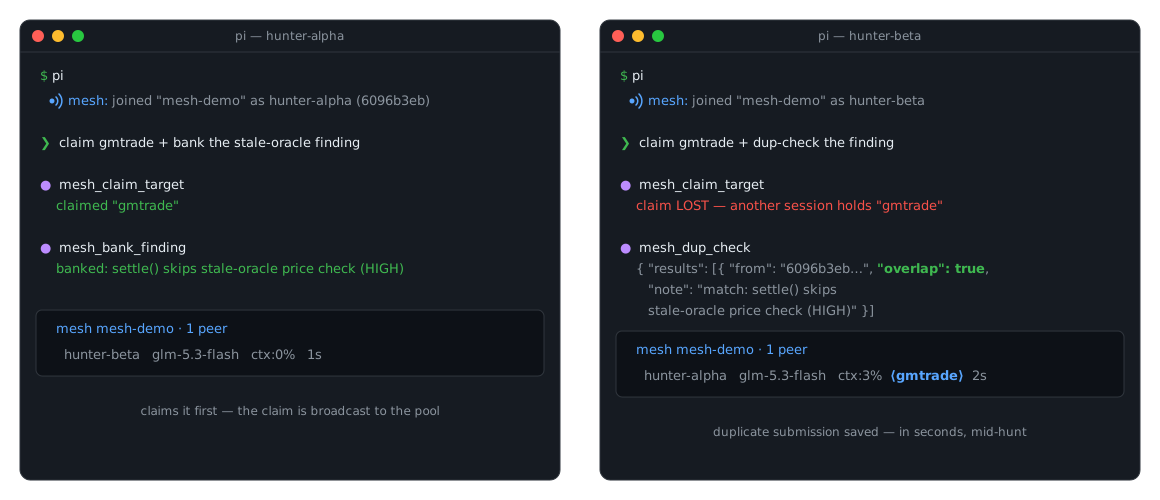
Real output from two live sessions in a shared pool. Zero config on one machine; one small hub process for cross-machine.
The problem
Every pi session is an isolated process. Run three in parallel — three bug-bounty hunts, three features, three refactors — and they're strangers: they duplicate each other's work, forget what the others learned, and die with their knowledge.
armory-mesh gives them a shared nervous system:
- Presence — each session sees the fleet live: who's running, on what model, how much context is left, what they're claiming. A session that dies is evicted automatically — no ghosts.
- Claims — atomic work claims (
mesh_claim_target) so two sessions never hunt the same target. A losing claimant is told no, and who holds it. - Duplicate checks —
mesh_dup_checksweeps the pool: "has anyone seen this bug?" Every peer answers from its ledger in seconds. An overlap reply is a duplicate submission saved. - Durable memory — findings banked at 02:00 with nobody online are replayed to whoever joins at 09:00. The fleet-state ledger (
fleet-state.jsonl) survives every session.
Quickstart
# user scope — available in every project, no trust prompt
pi install npm:@getpipher/armory-mesh

# or project scope — lives in .pi/settings.json, shared with the repo;
# pi auto-installs it on next start once you trust the project
pi install -l npm:@getpipher/armory-mesh

# a local checkout works too
pi install /path/to/armory-mesh
The
npm:prefix is required — a bare package name parses as a local path and fails.
Then fire your sessions. Each one prints the join line and grows a live fleet widget below the editor:
📡 mesh: joined "my-project" as agent-2cc1e9
mesh bug-bounty-fleet · 6 peers
  gmtrade-audit   glm-5.3-flash  ctx:34%  ⟨gmtrade⟩  1s
  veilo-recon     glm-5.3-flash  ctx:10%             1s
  hunter-3        glm-5.3-flash  ctx:67%             0s
  … +3 more peers
Presence updates every 2 seconds (name, model, live context-window usage, claimed target, last-seen). The widget collapses past PI_MESH_WIDGET_MAX_ROWS (default 10), most-recently-active first.
Running a session you don't want in the mesh at all? PI_MESH_OFF=1 pi … — the package stays installed, but that session registers no mesh surface (no tools, no widget, no socket, no key).
Who can see whom: a session joins the pool named by — in order of precedence — the PI_MESH_PROJECT env var, a .pi/mesh.json anywhere up its folder tree, or its working folder's basename. Same pool = visible to each other. Different pool = complete strangers. Knowledge itself only moves when a session calls a tool — presence metadata (heartbeats) is the only automatic traffic.
The tools (injected into every session)
| Tool | What it does |
|---|---|
mesh_list | Live peers: name, model, host, context usage, claimed target, last-seen |
mesh_send | Send a typed message to a peer or a channel |
mesh_get / mesh_await | Pull (fire-and-forget) or block for matching messages |
mesh_claim_target / mesh_release_target | Atomic work claims (filesystem-lock) — stale claims from dead sessions are auto-reclaimable |
mesh_bank_finding | Announce + permanently persist a finding |
mesh_dup_check | "Has anyone seen this?" — every peer answers from its ledger in seconds |
mesh_handoff | Publish a resume pointer for the next session |
mesh_fleet_state | Read the durable ledger (claims, findings, dup-checks, handoffs) |
mesh_channels | Channels + live subscriber counts |
Slash commands for the human at the keyboard: /mesh (pool status) and /mesh doctor (full install + runtime diagnostics — wiring, trust, key, transport, peers, claims, ledger).
The workflow it enables
- Claim before you start —
mesh_claim_target("gmtrade"). A duplicate claimant is told no, and who holds it. - Bank at milestones —
mesh_bank_finding(...)writes through tofleet-state.jsonland broadcasts on#dup-check. Even with zero peers online, it's durable. - Check before you submit —
mesh_dup_check(...)sweeps the fleet. An overlap reply is a duplicate submission saved. - Handoff on exit —
mesh_handoff(...)so the next session resumes instead of restarting.
How it works
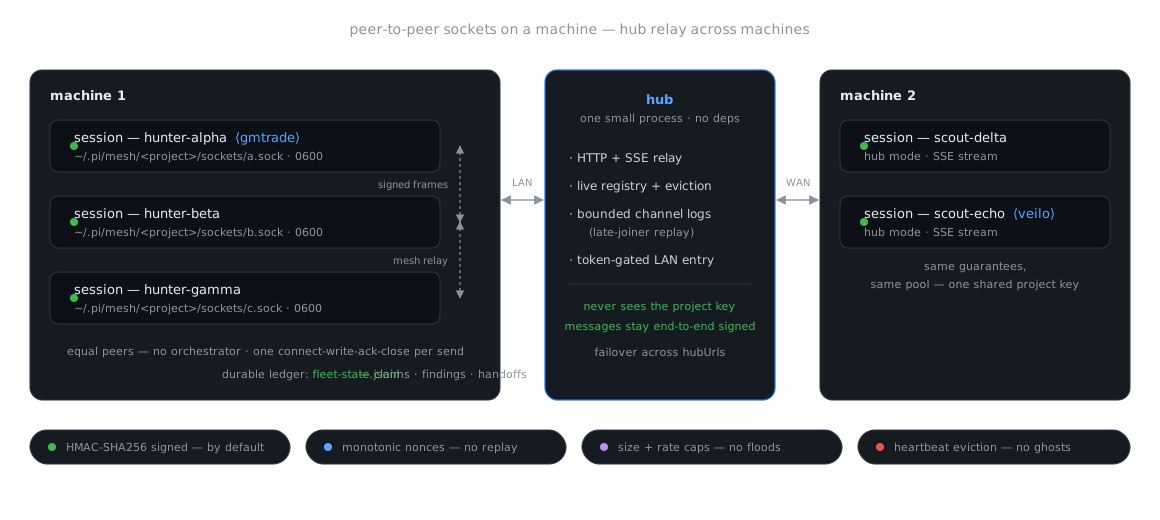
- Same machine: each session listens on a private Unix socket (
~/.pi/mesh/<project>/sockets/<id>.sock, 0600). Sending = connect → write one length-prefixed JSON frame → ack → close. - Cross-machine: a small hub relays over HTTP + SSE.
- Unreachable peer? Mesh relay: a peer that can reach the destination forwards the frame — with a visited-set + hop-count so loops are impossible.
- Persistence: senders write through to per-channel logs (local: shared
ndjson; hub: a disk-backed store under~/.pi/mesh/that survives hub restarts) — the durable ledger (fleet-state.jsonl) is always written.
Security (by default, even on localhost)
- Project key — 32 random bytes per pool (
~/.pi/mesh/<project>/key, 0600). Every message is HMAC-SHA256 signed over a canonical encoding; receivers verify with a timing-safe compare and drop forgeries. - Replay protection — per-sender monotonic nonces; a captured frame can't be re-injected.
- Hub LAN gate — the hub requires its own token and never sees the project key; it's a dumb relay, messages stay end-to-end signed.
- Flood caps — per-message size cap (256 KB), per-channel rate cap (10 msg/s), bounded queues.
- Full threat model + residual risks: SECURITY.md.
Cross-machine: the hub
# machine A — the hub (one process, no deps)
PI_MESH_AUTH_TOKEN=<secret> PI_MESH_HUB_PORT=7399 npx jiti src/hub.ts

# machine B — point sessions at it (and copy the project key across)
PI_MESH_HUB_URL=http://<A>:7399 PI_MESH_AUTH_TOKEN=<same-secret> pi
The hub holds the cross-machine registry, relays messages, and keeps bounded per-channel history for late-joiner replay — on disk, so a hub restart no longer wipes the catch-up history (PI_MESH_STORE_PATH to relocate, =off for memory-only). Clients fail over automatically across PI_MESH_HUB_URLS (comma-separated) if the primary dies — and a reconnect back-fills exactly the messages missed while the stream was down (proven by the reconnect smoke). Run the hub on infrastructure you trust; terminate TLS in front of it if it leaves the LAN.
Project-scoped pools
Drop a .pi/mesh.json at any workspace root and every session fired under it joins the same pool — regardless of which subfolder it was launched from:
{
  "project": "my-fleet",
  "persistChannels": ["#dup-check", "#handoff", "#general", "#learnings"]
}
Precedence: PI_MESH_PROJECT env → nearest .pi/mesh.json → folder basename.
Configuration (env)
| Variable | Default | Meaning |
|---|---|---|
PI_MESH_OFF | — | Per-session opt-out: 1/true/yes/on → this session registers no mesh surface (package stays installed) |
PI_MESH_PROJECT | folder basename | Pool id |
PI_MESH_AGENT_NAME | random | Readable name in the widget |
PI_MESH_HUB_URL / PI_MESH_HUB_URLS | — | Hub endpoint(s) — cross-machine mode |
PI_MESH_AUTH_TOKEN | — | Required for hub mode |
PI_MESH_STORE_PATH | ~/.pi/mesh/hub-store.ndjson | Hub replay store (set off for memory-only) |
PI_MESH_PING_MS / PI_MESH_EVICTION_MISSES | 2000 / 5 | Heartbeat interval / eviction window |
PI_MESH_MAX_MESSAGE_BYTES | 262144 | Per-message cap |
PI_MESH_CHANNEL_RATE_PER_SEC | 10 | Per-channel send-rate cap |
PI_MESH_MAX_HOPS | 8 | Mesh-relay hop limit |
PI_MESH_WIDGET_MAX_ROWS | 10 | Pool-widget peer rows before collapsing into "… +K more" |
PI_MESH_PERSIST_CHANNELS | #dup-check,#handoff,#general | Channels with durable logs |
Why not just use coms?
coms (disler) pioneered peer-to-peer pi messaging — armory-mesh is the hardened evolution.
coms | armory-mesh | |
|---|---|---|
| Pool size | N peers | N peers (bounded relay + caps) |
| Auth | — | project key + HMAC-signed frames, even on localhost |
| Replay protection | — | monotonic nonces, timing-safe verify |
| Liveness | keepalive pings | signed heartbeat gossip + auto-eviction (no ghosts) |
| Messages | text lines | typed messages + subscription-scoped channels |
| Persistence | — | send-through logs + late-joiner replay + durable fleet ledger |
| Fleet primitives | — | claim / bank / dup-check / handoff, built in |
| Cross-machine | separate codepath | unified transport: sockets ↔ hub, with failover + relay |
| Abuse limits | line cap | 256 KB per-message + 10 msg/s per-channel caps + mesh relay loop prevention |
coms is a great chat wire; armory-mesh is a fleet operating layer.
Status
🚀 v0.1.x — built and hardened through 12 smoke-tested suites (transport, liveness, channels, persistence, fleet-state, hub, relay/failover/replay, hardening, wiring, diagnostics, reconnect), running in a live multi-session security-hunting fleet. API may still shift before 1.0.
- DESIGN.md — architecture + the hardened guarantees
- ROADMAP.md — build phases
- SECURITY.md — trust models + residual risks
License
MIT